

A different model for enterprise automation
In almost every enterprise conversation, our sales team hears the same shortcut.
So you are like n8n?
It is a reasonable comparison point. Both platforms automate work across systems. Both can call tools and run code. Both can connect to the same operational stack of data sources, internal services, and SaaS systems.
But when automation becomes business critical, enterprise buyers care less about the workflow builder interface and far more about the properties of the system underneath. They care about verifiable outcomes, resistance to hallucinations, traceability that holds up in audits, governance and security controls that scale, faster iteration without workflow sprawl, and ownership that does not collapse into a small group of specialists.
That is where the comparison breaks down.
The similarity that creates confusion is real. Both approaches use code to get work done. The difference is when that code is formed, how the process is defined, and what the system treats as proof. Those choices determine cost, risk, and speed once you move from prototypes into production.
This article explains where the difference really comes from and why it matters for complex, exception heavy enterprise processes.
A focused comparison on what enterprise buyers actually care about
The real distinction is the unit of automation
n8n is excellent at orchestration. You assemble a workflow graph at design time using nodes, conditions, retries, and integrations. Reliability is a function of how thoroughly you modeled the process and how well you handled exceptions inside the graph.
That works extremely well when the process is stable and inputs are predictable.
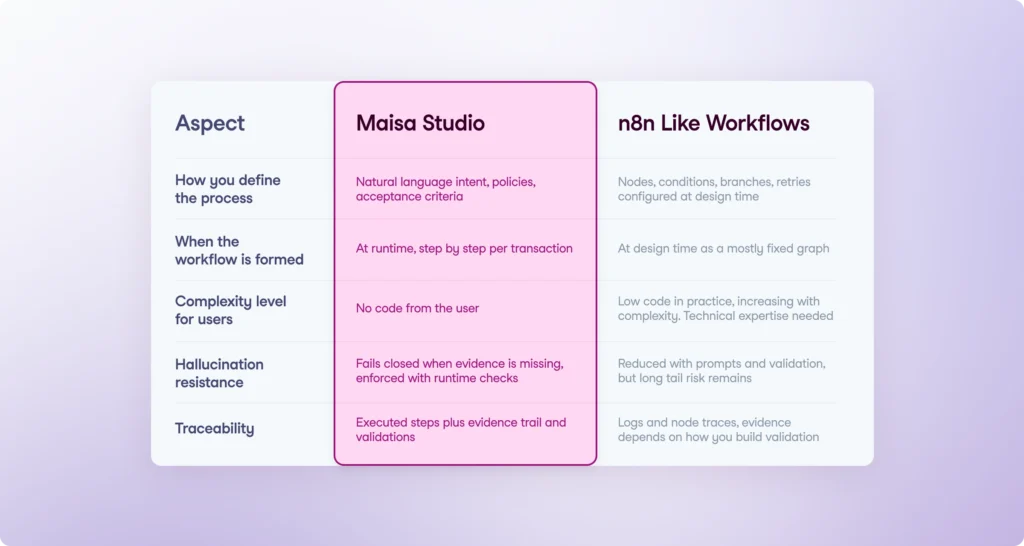
Maisa starts from a different premise. In Maisa Studio you define work in natural language at the level of objective, constraints, policies, and acceptance criteria. Then the KPU executes the work. The key point is when and how the workflow exists.
With Maisa, the process is formed at runtime. The KPU generates executable steps, runs them in a controlled environment, observes the results, validates them against rules and invariants, and then decides the next step. The system is not following a fixed blueprint you had to anticipate in advance. It assembles and verifies the steps as each transaction unfolds, under the governance you define.
This is not just a product design preference. It changes the economics of automation when the real world is messy.
If your process looks like a stable integration diagram, a workflow graph is a natural fit.
If your process looks like documents, exceptions, inconsistent formats, and edge cases, objective driven execution changes what is feasible.
How you define the process determines who can own it
In a workflow graph model, the process is defined as structure. Nodes represent operations. Conditions represent decisions. Branches represent exceptions. Retries represent resilience. The process is the graph.
In an enterprise setting, that definition has consequences. When the process is encoded as a detailed graph, the people who can safely modify it are typically the people who understand the graph as a system. Over time, ownership concentrates because the workflow becomes both business logic and production software at the same time.
In Maisa, the process is defined as intent plus constraints. The user expresses what success looks like, what policies apply, and what acceptance criteria must be satisfied. That moves the primary definition of the process closer to business language. It also makes it easier for compliance and security to review rules in the form they already use.
The operational shift is simple. Instead of asking who can safely edit the workflow graph, teams ask who owns the policy and acceptance criteria.
When the workflow is formed changes how the system handles variance
Enterprise processes are rarely stable. Auto loans, onboarding, KYC, trade finance, claims, and back office operations are full of variance. Templates change. Documents arrive incomplete. Fields move. Edge cases appear after deployment, not before.
In a design time workflow graph, variance is handled by adding more structure. That usually means more branches, more conditional logic, more special cases, and more retries. Over time, the graph becomes a decision tree. Every new exception becomes a new path that must be maintained and tested. Change becomes expensive because a policy update can touch multiple branches and regressions are hard to reason about.
Maisa is designed around runtime formation. The KPU generates steps as it executes. It observes what happens and adapts to the specific transaction. When it encounters a new corner case, it can generate the code needed to handle that case in the moment rather than failing simply because the path was not modeled in advance. When the same conditions repeat, the system can reuse proven paths rather than regenerating unnecessarily.
The practical result is that you do not need months of corner case engineering just to keep the system functional as variance grows.
Hallucination resistance is not a prompt problem, it is a system property
When enterprise buyers talk about hallucinations, they are not describing quirky model behavior. They mean the system produced a plausible value that was not supported by the underlying documents or data, and that value made it into the output.
In many workflow plus AI setups, the typical response is to improve prompts, enforce structured output, add retries, and wrap model calls with validation. These techniques help, but they do not eliminate the long tail. In production, the long tail is where risk lives.
There is a second issue that makes this worse. Many systems rely on confidence scores to decide whether to proceed, retry, or escalate. But confidence is not correctness. A model can be highly confident about an answer that is unsupported by evidence. Confidence can create the appearance of control without guaranteeing reliability.
Maisa addresses hallucination risk by enforcing an execution backed contract. The system is required to justify outputs through executed steps and validations. If evidence is missing, it should not invent it. If totals do not reconcile, it should not approximate. If a policy forbids inference, that rule is enforced in runtime behavior, not merely suggested in a prompt.
This is what buyers actually want when they say they need hallucination resistance. They want a system that fails closed when proof is missing.
Traceability that survives audits requires more than logs
Most workflow platforms can show you that a node ran, an API call was made, and an output was produced. That is useful. But once you add generative steps, logs can end up recording what the model returned rather than the evidence that supports the result.
For enterprise buyers, traceability is not only about debugging. It is about governance and auditability. When something goes wrong, teams need to answer questions like these.
What evidence supported this value
Which rule allowed this decision
What validations passed
What checks failed and how was the exception handled
Maisa is designed so the evidence trail is intrinsic. The KPU executes steps and validations in a controlled runtime. Outputs are backed by those executed actions. The trace becomes a receipt of what was done, what was checked, and what evidence was produced.
In n8n like systems, traceability depends on how you build the workflow. You can add validation and evidence capture. You can create robust audit logs. But it is not inherent to the model. It is something you engineer per workflow, and that means its quality varies across workflows, teams, and time.
This difference becomes visible during incident reviews and compliance reviews. It is the difference between reconstructing what happened from logs and having the system produce a clear evidence trail as part of execution.
Complexity level for users determines whether adoption scales
n8n is described as low code. In practice, as soon as a workflow matters, teams add expressions, error handling, branching logic, and sometimes Code nodes. That is normal and often necessary for production robustness. The consequence is that the people who can safely build and change workflows are relatively technical.
This is not inherently bad. It is a strong fit for IT owned integration orchestration. It becomes a constraint when the process lives with operations teams and changes frequently. In those environments, each new exception becomes a ticket and each policy update becomes a workflow edit.
Maisa is designed to be no code from the user perspective. Operations teams define objectives, constraints, and acceptance criteria in natural language. Compliance can review the policies directly. IT and engineering focus on integrations and runtime boundaries rather than continuously rewriting business logic.
The outcome is not just ease of use. It is scalable ownership and predictable cost. The people accountable for outcomes can participate directly without needing to become workflow engineers.
When to use which model
If your work is mostly stable integrations with predictable steps, and your correctness requirements are satisfied by deterministic nodes plus straightforward validations, n8n like workflows can be a great fit. n8n 2.0 strengthens that case with improvements aimed at production execution, safer change management, and a more secure by default posture.
If your work is high variance, document heavy, exception heavy, and high stakes, the runtime execution model matters far more than the workflow builder interface. This is the world of auto loans, trade finance, onboarding, and back office operations where edge cases are normal and the cost of silent errors is high.
That is where Maisa Studio and the KPU are designed to win. Not by adding AI to workflows, but by changing what automation means when correctness, governance, and adaptability are non negotiable.
Why this matters to the business
These differences map directly to business outcomes.
When outputs are grounded in execution and verified through checks, the risk of silent errors drops. When the system adapts at runtime rather than forcing you to pre model every corner case, time to value improves and expansions do not turn into months of workflow engineering. When ownership is expressed as intent and policy rather than graph complexity, iteration speeds up without losing control. When traceability is an evidence trail, audits and incident reviews get simpler and faster.
This is why the n8n comparison appears so often. n8n is a strong baseline for orchestration, and it is improving as a production platform. Maisa is built for the cases where orchestration alone is not enough and you need trusted execution, outcomes that can be verified, work that adapts to messy reality, and a governance model that scales with complexity.